SPLIT.IO: A Game About Where You Look
Most action games test your hands. SPLIT.IO tests your eyes. The screen is divided into two arenas, each with its own shape and its own stream of threats. Tapping doesn't move either shape. It decides which one is exposed.
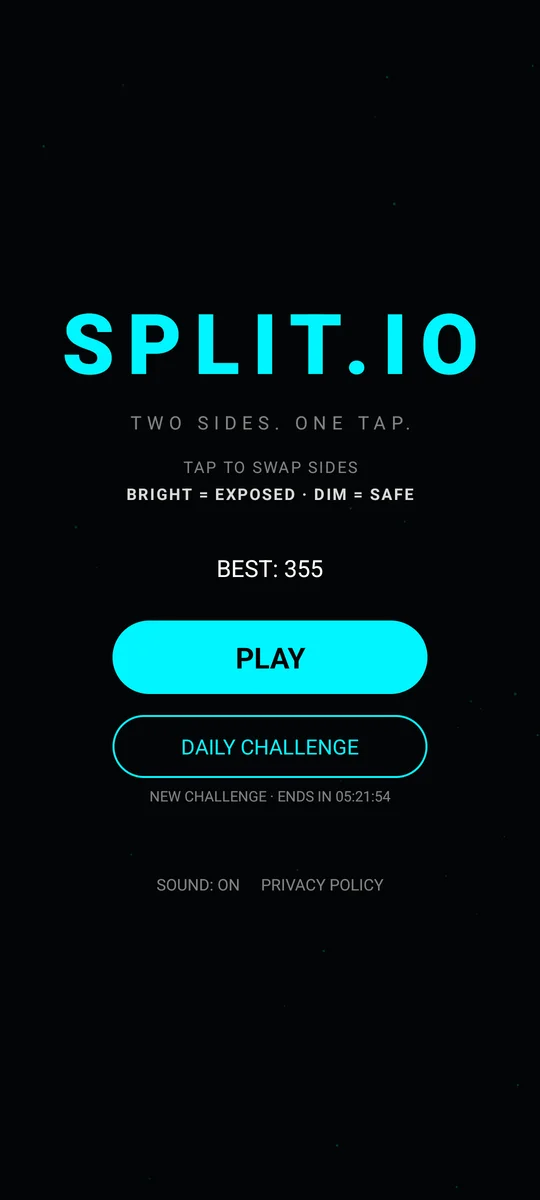
SPLIT.IO, recorded from the Android app.
Exposed and protected
At any moment, one side is bright and the other is dim. The bright side is exposed: threats that touch its shape cost a life. The dim side is protected: threats pass straight through. Every tap swaps them.
That makes the real skill tracking two separate situations at once and deciding which needs protecting next. The tap is trivial. Knowing when to tap is the whole game.
Shared lives
You have three lives, shared across both sides. That's important: it means you can't specialize. A player who watches one side carefully and neglects the other loses just as fast as one who panics. After losing a life you get a short mercy window where hits are absorbed, which gives you a moment to recover attention, not just a moment to recover.
Rewards for staying exposed
A threat that passes close to your exposed shape and misses earns a close call. Three close calls in a row trigger SLOW-MO, which slows both sides for five seconds. That design is deliberate. The safest play is to keep the threatened side protected, but the rewarding play is to leave it exposed and trust your read of the threat's path.
Two other power-ups come from milestones. Every 15 threats dodged triggers CLEAR, which wipes the field instantly. Every 30 seconds survived triggers 2× SCORE for ten seconds. If SLOW-MO is running when 2× SCORE arrives, it waits until SLOW-MO ends, so you never lose a power-up to bad timing.
Threats designed to split your focus
SPLIT.IO's six threat types all arrive in the first 50 seconds, and each one asks for a different kind of attention. Darts fly straight and are easy to read at a glance. Drifters curve slightly, so they arrive later than they look. Trackers correct course toward you, so they can't be ignored. Pulses are expanding rings that can't be avoided by position, only by protection. Bursts split into fragments, turning one threat into a flurry. Ghosts fade from view, leaving only a faint outline, so you have to keep tracking something you can barely see.
The SPLIT.IO guide has tips for each.
More from the Devlog
The design rule behind the whole catalog: one verb per game, and why constraint produces better arcade games than features do.
How the Daily Challenge turns a calendar date into a run that's identical for everyone, and why that makes scores fair.
ORBIT.IO, DODGE.IO and SPLIT.IO began as Android apps. Their browser versions are line-by-line ports. Here's what that took.