Designing ORBIT.IO's Difficulty Curve
ORBIT.IO has one control: tap to reverse. All of its difficulty comes from what it throws at you and when. This post walks through how a run escalates, and the rules that keep it fair.
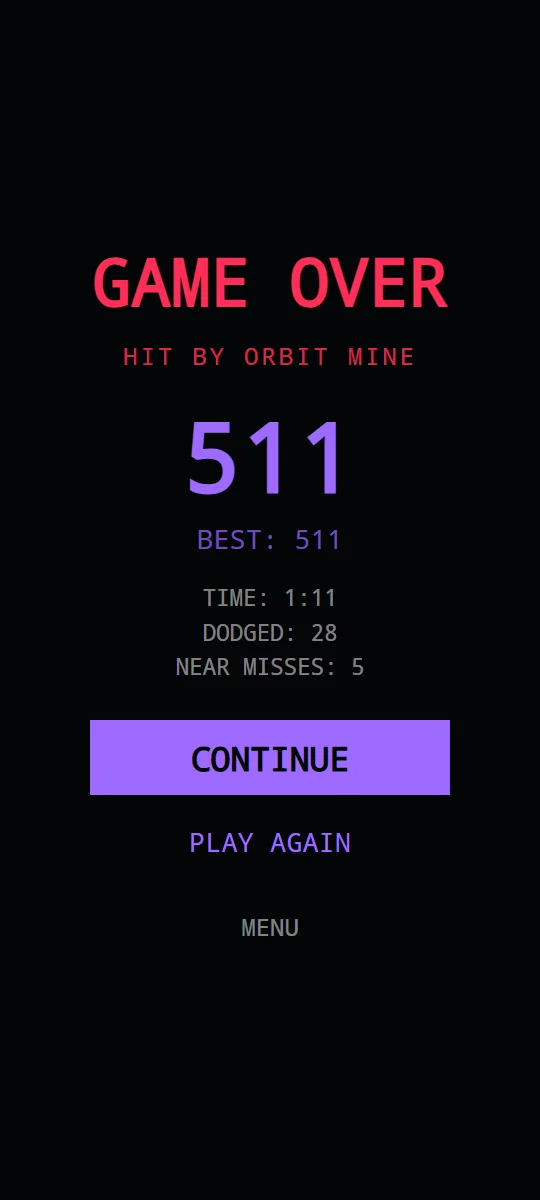
ORBIT.IO, recorded from the browser game.
The unlock schedule
A run starts with a single threat type and adds a new one at fixed times:
- 0:00 Inbounds fly in from off screen toward the orbit.
- 0:15 Orbit Mines appear on the track itself.
- 0:35 Chasers appear behind you and slowly catch up.
- 1:00 Pulse Rings expand outward with a gap you have to be in.
- 1:30 Reversers ride the track toward you head on.
- 2:20 Shrinkers pull your orbit inward for a few seconds.
Inbounds stay the most common threat for the whole run. They're three times as likely to be picked as any other type. New threats add variety; they don't replace the basics.
Each new threat asks a new question
The order isn't arbitrary. Each addition changes what a reversal means.
Inbounds teach you to read angles. Mines make part of the track off-limits, so your usable orbit gets shorter. Chasers punish careless reversing, because tapping turns you straight into them. Pulse Rings flip the logic: sometimes the right move is not to tap at all, because the gap in the ring is already coming to you. Reversers come from the front, so now both directions can be dangerous at once. Shrinkers change the geometry, making everything arrive sooner.
By the time all six are in play, a single tap has to account for what's ahead, what's behind, what's on the track and what's coming in from outside.
Fairness rules
A hard game only works if deaths feel earned. ORBIT.IO has several rules built in to make sure a threat never comes out of nowhere:
- Inbounds are always visible before they can hit you. Each one is slowed if necessary so it's on screen for at least about a second before it can reach the orbit.
- Mines spawn far from you, at least about 150 degrees around the track in either direction, and can't hurt you while they're fading in.
- Chasers and Reversers fade in as hollow outlines before they become solid, so you always see them before they matter.
- Pulse Ring gaps start near your position, so the escape is always reachable.
- Shrinkers warn you first with a pulsing ring showing exactly where the orbit will shrink to.
Rewarding risk
The last piece is the shield. Every five near misses earns one. That means the safest-looking strategy, staying as far from everything as possible, is actually the weaker one. Players who let threats skim past bank shields for the brutal final stretch. After two minutes your score also doubles per second, so surviving deep into a run pays off twice.
The full threat breakdown, with tips for each, is in the ORBIT.IO guide.
More from the Devlog
The design rule behind the whole catalog: one verb per game, and why constraint produces better arcade games than features do.
How the Daily Challenge turns a calendar date into a run that's identical for everyone, and why that makes scores fair.
ORBIT.IO, DODGE.IO and SPLIT.IO began as Android apps. Their browser versions are line-by-line ports. Here's what that took.