Designing INK.IO: Walls That Last a Heartbeat
INK.IO started from a question: what if the thing you block with is also the thing you attack with? Threats fall toward five lamps at the bottom of the screen. You drag a finger to draw a wall. Anything that hits the wall bounces off and turns friendly, destroying any other threat it crashes into.
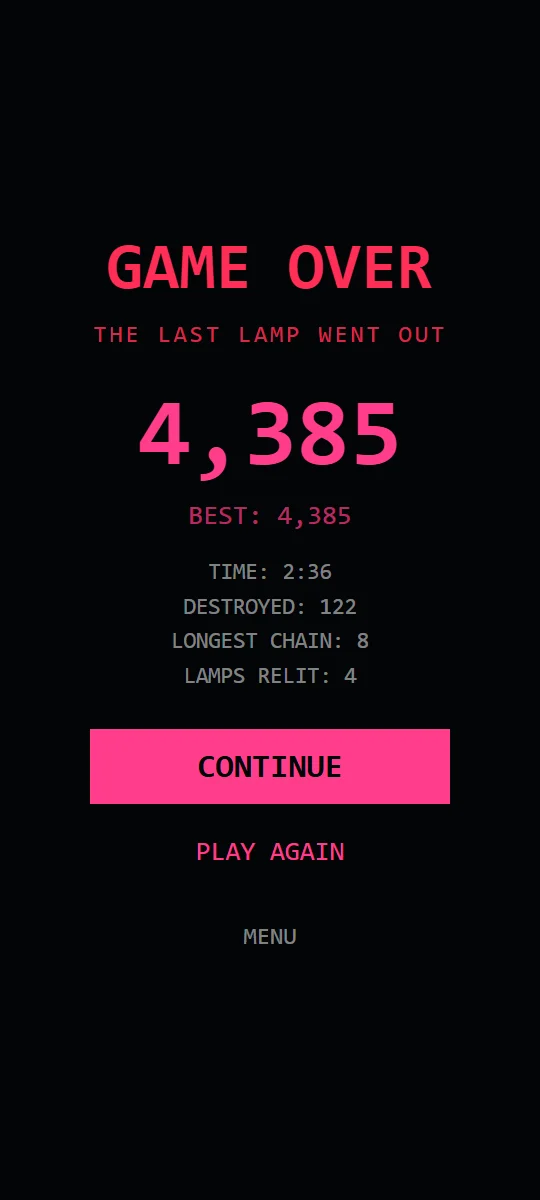
INK.IO, recorded from the browser game.
Short-lived walls
The walls only last a moment. That was a deliberate choice. Permanent walls would let a player draw a shelf over the lamps and wait. Brief walls force you to draw at the right moment, in the right place, at the right angle. The skill isn't building defenses; it's reacting.
Limited ink
Ink is also limited. The meter drains as you draw and only starts refilling after you lift your finger. Long walls empty it fast. This is what makes angle matter: a short wall that sends a threat into three others is far better than a long wall that just stops one.
Chains
Every kill caused by threats bounced from the same stroke belongs to one chain, and each kill in a chain is worth more than the last. The first kill pays its base value, the second pays double, the third triple. One well-angled stroke can be worth more than a minute of careful blocking.
Chains also matter for survival. Reach five kills in one chain and a lamp that went dark lights back up. If all five lamps are already lit, you get a 100-point bonus instead. It's the only way to recover a lost lamp, so a player who's falling behind has a reason to take risks rather than just play safe.
Threats that change the angle
INK.IO adds six threat types over its first 100 seconds, each designed to break a habit:
- Drops fall straight. They teach the basics and become ammunition.
- Zigzags weave, so a wall drawn too early misses.
- Clusters burst into three shards when bounced: an instant chain starter.
- Divers fall, pause, then dive fast at a lamp. The pause is your window.
- Slips phase in and out, passing through ink while faded.
- Heavies smash through walls instead of bouncing. You can only slow them down.
The last two are the most important, because they're the threats your favorite move doesn't work on. The full breakdown is in the INK.IO guide.
More from the Devlog
The design rule behind the whole catalog: one verb per game, and why constraint produces better arcade games than features do.
How the Daily Challenge turns a calendar date into a run that's identical for everyone, and why that makes scores fair.
ORBIT.IO, DODGE.IO and SPLIT.IO began as Android apps. Their browser versions are line-by-line ports. Here's what that took.