GROUND.IO and the Risk of Holding On Too Long
In GROUND.IO you're a core that can't move. Threats walk in from every side. Your only action is to hold anywhere to charge a shockwave and release to fire it. That gives the game exactly one decision, made over and over: when do you let go?
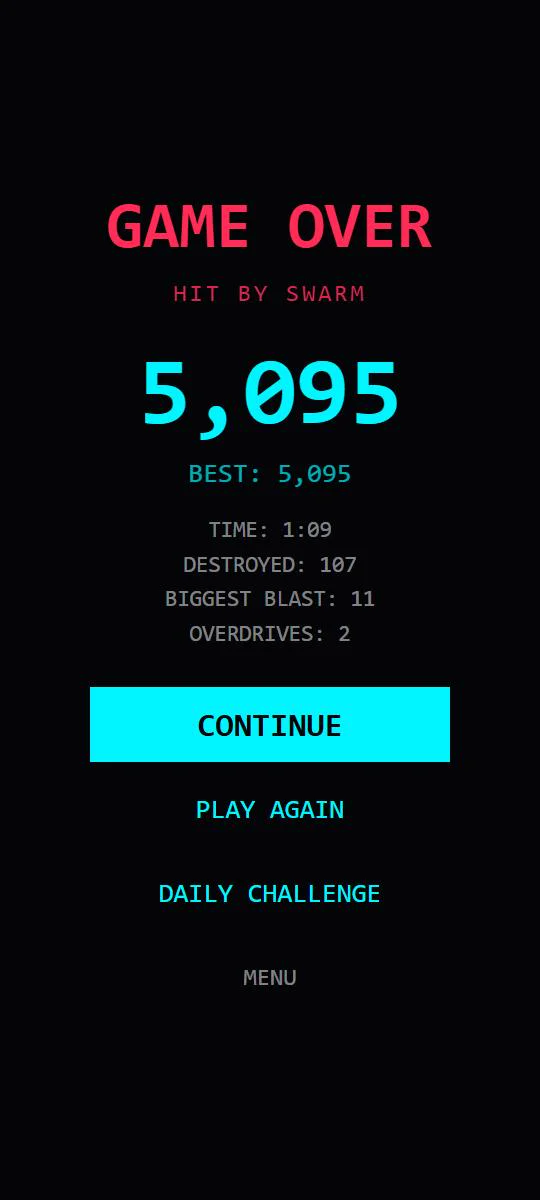
GROUND.IO, recorded from the browser game.
Every option has a cost
A short hold makes a small blast that recovers quickly. A long hold makes a big blast that reaches farther, but leaves the core helpless for longer while it recovers. Neither is correct. A small blast is the right answer to a single Rusher about to dash; a big one is the right answer to a ring of Crawlers closing in. The game is reading which situation you're in.
Overdrive: the greedy option
Hold past a full charge and the core goes into Overdrive. An Overdrive blast scores double and destroys armored Shells in one hit instead of two. But Overdrive is a fuse. Hold one beat too long and the core Overloads and explodes, ending the run unless you're carrying a shield.
That's the heart of the design: the most rewarding play and the most dangerous play are the same action, separated by a fraction of a second. Players learn the rhythm by feel. Early on, almost nobody risks it. Later, good players go into Overdrive on purpose whenever a Shell is on screen.
Scoring that rewards patience
Each blast adds up the points of everything it destroyed, then multiplies the total by the number of kills in that blast. Destroying five Crawlers one at a time is worth 50 points. Destroying them in one blast is worth 250. Do it in Overdrive and it's 500.
That multiplier is deliberately strong. It pushes players to wait, to let threats bunch up, to hold their nerve a little longer than is comfortable, which is exactly what makes Overload a real danger.
The shield as a reward for greed
Destroy eight threats with a single blast and you earn a shield. The shield absorbs one hit, or one Overload. So the most effective way to protect yourself from greed is to be greedy successfully. Big blasts earn the safety net that makes the next big blast less frightening.
Threats that test the decision
Each of GROUND.IO's six threat types attacks the hold-and-release decision differently. Swarms reward waiting because five small threats arrive in a tight formation. Rushers punish waiting because they stop, flash, and dash. Forks punish big slow blasts by splitting into homing fragments that arrive during your recovery. Lurkers circle the edge out of range and dive when you least want them to.
The GROUND.IO guide covers each one, with point values and how to handle them.
More from the Devlog
The design rule behind the whole catalog: one verb per game, and why constraint produces better arcade games than features do.
How the Daily Challenge turns a calendar date into a run that's identical for everyone, and why that makes scores fair.
ORBIT.IO, DODGE.IO and SPLIT.IO began as Android apps. Their browser versions are line-by-line ports. Here's what that took.