Tuning Don't Squish Bob After Playtesters Said "Too Easy"
The first playtest verdict on DON'T SQUISH BOB was blunt: too easy. The second, after a round of changes, was "slightly harder." This post covers what changed between those versions and what the tuning taught me about difficulty.
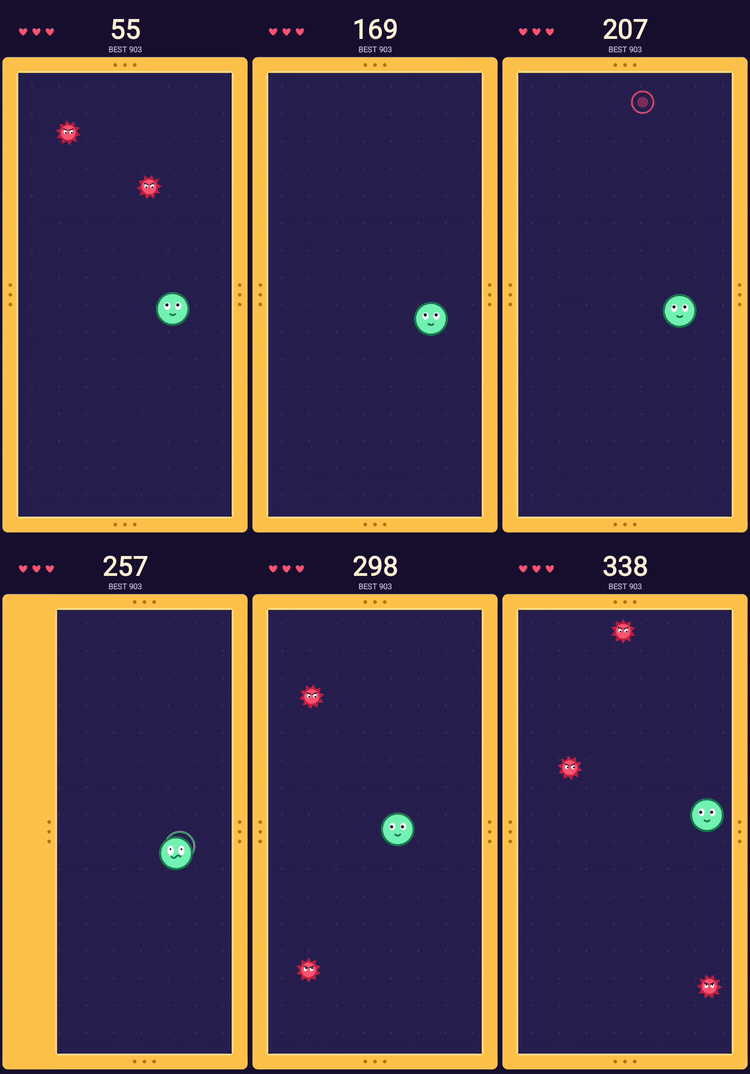
A run of DON'T SQUISH BOB.
The original problem: a ceiling
In the first version, the number of spikes in the box climbed for a while and then stopped. From about 84 seconds into a run, the box held at most nine spikes, and it stayed that way. Once a player could handle nine, they could handle the rest of the run indefinitely. The game had a ceiling, and good players reached it.
Round one: raise the speed
The first fix was straightforward: spikes got about 8 percent faster. That helped, but speed alone doesn't change the shape of a run. A frozen difficulty curve that's slightly faster is still frozen.
Round two: change the shape
The second round changed how a run escalates rather than just how fast things move:
- A busier start. More happens early, so the first thirty seconds aren't a warm-up.
- No more ceiling. The spike cap now keeps climbing, up to 13.
- Late-game heat. From about 40 seconds in, newly spawned spikes travel faster, rising toward 75 percent faster late in a run. Spikes already in flight keep their speed, so the change is gradual rather than sudden.
- Less warning. The pulsing marker before a spike appears starts at 0.8 seconds and shrinks to about half a second as the run heats up.
- Less personal space. Late spawns are allowed to land closer to Bob, so a big purge is followed by a replacement wave that's genuinely threatening.
Speed went up another 5 percent on top of all of that.
What I learned
Difficulty isn't one number. Making things faster is the obvious lever, but it's the least interesting one. The changes that mattered most were about information and space: how much warning you get, how close danger can appear, and whether the game keeps asking more of you or settles into a routine.
The other lesson was to take "too easy" seriously even when it's uncomfortable. A game you can't lose isn't relaxing; it's boring. The first version was too forgiving, and two rounds of honest feedback fixed it.
See the Don't Squish Bob guide for how to survive the current version.
More from the Devlog
The design rule behind the whole catalog: one verb per game, and why constraint produces better arcade games than features do.
How the Daily Challenge turns a calendar date into a run that's identical for everyone, and why that makes scores fair.
ORBIT.IO, DODGE.IO and SPLIT.IO began as Android apps. Their browser versions are line-by-line ports. Here's what that took.